18 August 2011

Signs of Late Summer

Last time I blinked it was the end of July and school was starting. One more blink, and August was magically half over. As I listen to a wonderful severe thunderstorm rumbling outside, I'm reminded that we still have plenty of time left in the growing season; however, the signs are there that summer is on the wane.These are our Phlox paniculata, 'David's lavender' and 'David.' They grow approximately 4-5' tall, and the flower heads get so big and heavy that they tend to flop over, especially after a heavy rain. My dad and I built cages for them out of copper pipe. I learned how to cut and solder pipe, which barely scratches the surface of all the amazing things my dad can do with tools (he's a machinist). The pipe has darkened to a beautiful patina, and the phlox no longer do a nosedive after summer thunderstorms.These are some of the few non-natives in the flower garden. I first saw the lamb's ear while visiting the Well-Sweep Herb Farm in Port Murray, NJ with my cooking students. As one of them said, it's so soft that you would want to make a pillow out of the leaves. The flowers are lantana, a big favorite of nectar-loving insects. I like them because each flower is so tiny.Joe Pye weed, Eupatorium purpureum, is a native that butterflies, moths, and bees absolutely adore. It is fascinating to watch bees forage in the blossoms, growing their pollen baskets on their legs, and fly off...only to return almost immediately for more of the good stuff. We also see a lot of yellow tiger swallowtails making a snack of it.Finally, in this corner...northern bayberry, Myrica pensylvanica, in the back, and Rudbeckia fulgida, black-eyed Susans, in the front. The bayberry is female and is growing its little berries, which are now light green but will fade into a dusky gray-blue in a few months. The black-eyed Susans stay in bloom from August through September, and we leave the seed heads up all winter for the birds. They are an especial favorite of the dark-eyed juncos and goldfinches. They are also a big hit with tiny black ants.

Another sign of late summer is that the crabgrass is going to seed. Sparrows will get buried in patches of it, and pop up and down as they grab at more seeds. It almost makes up for the crabgrass part.

Next up...hopefully...our first sweet potato harvest. Wish us luck!

07 August 2011

Warriors in the ISF

Brian adopted a trail, through the New York New Jersey Trail Conference, last year. It's in Stokes State Forest in northwestern NJ - right where my school's freshmen go backpacking each May - and he keeps it clean and passable. It always has fun things to see - a bear one time, a small lizard the next - and this time, mushrooms took the prize.

We got the opportunity to take our service project a step further this spring by joining the Invasives Strike Force, a program through the trail conference to map the locations of invasive species. The idea is that workers can be sent out to eradicate invasives in areas where they haven't completely taken hold and pushed out native plants. Why is this important? Native plants provide food and shelter for wildlife, nesting sites for birds, tend not to choke out waterways, and contribute to ecosystem diversity.

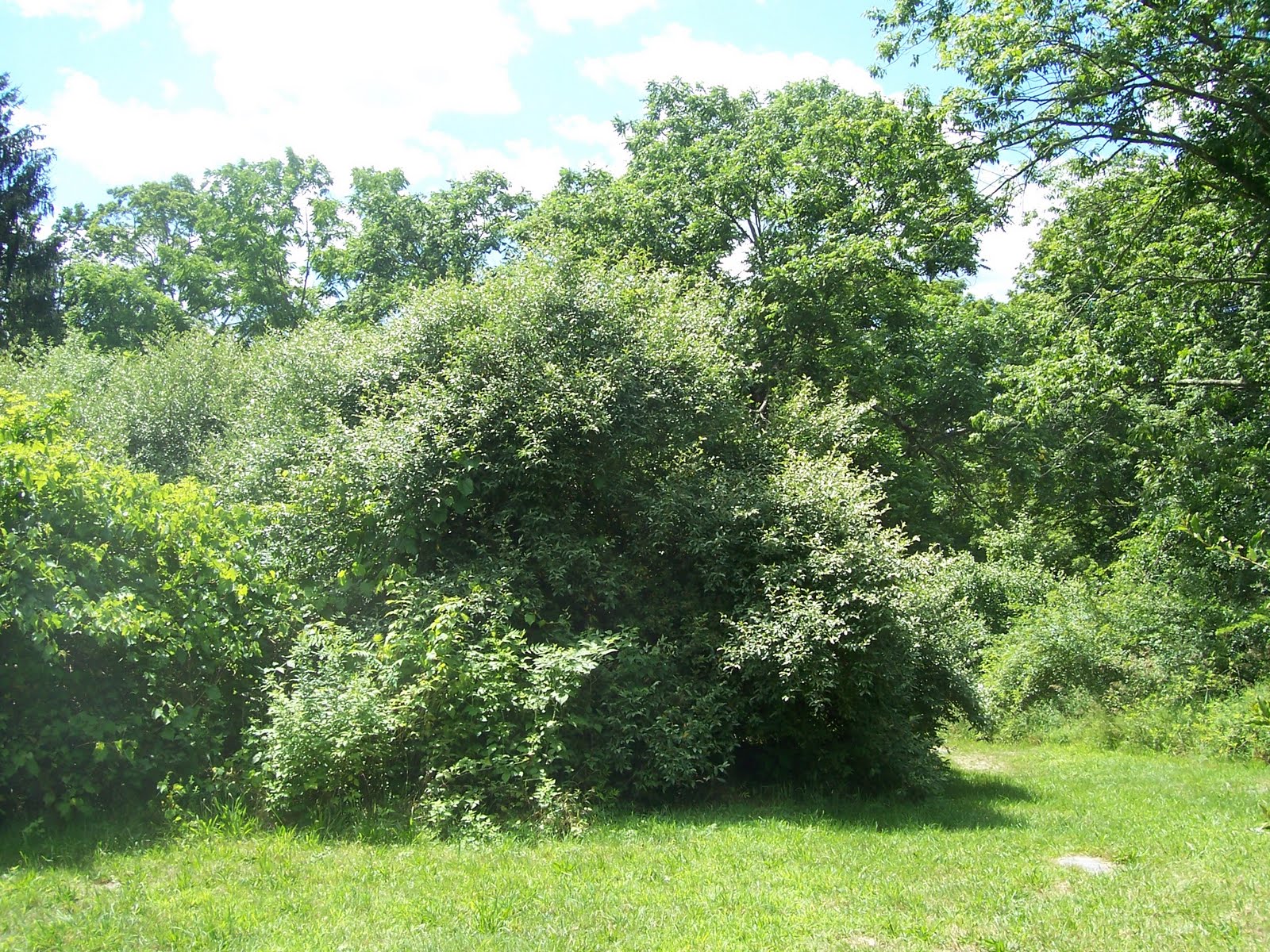
Today I would like to highlight two invasive species, multiflora rose and autumn olive. They get really big and can take over an area easily.
Meet Elaeagnus umbellata, autumn olive. I'm so disappointed this is invasive. Its leaves undulate along the edges, and each one is dotted with silver spots that give the foliage an overall sheen from a distance.
Now that I am properly acquainted with this plant, I see it by the side of the parkway all over the place.
This is Rosa multiflora, not to be confused with the native Carolina rose. This highly invasive species has white flowers, while the native has pink ones.The giveaway field marks that distinguish multiflora from Carolina rose are the recurved thorns (thorns that curve down, rather than up) and fringed stipules (the base of the stem, where it attaches to the main branch, looks feathery).

What can you do if you find an invasive in your yard? Eradicate it. Some can simply be pulled up, while others need to be poisoned. An internet search can help you determine the right method for a particular plant.

01 August 2011

I've Got the Blues

I've just finished our first week back to school (we have a bit of a non-traditional schedule), and even though it is still summer outside, being back in a classroom makes me feel like cold and miserable winter is peeking over my shoulder. I love my job, but it gets in the way of digging in the dirt and slaying Japanese beetles.

We were trying to decide how to prepare our blue potatoes, and decided to use my Aunt Pat's fabulous potato salad recipe with them. It is a little odd-looking, but very tasty, and eating periwinkle-colored potato salad has grown on me.
I'd also like to share a product recommendation...Repels-All. The cutest, tiniest little rabbit was doing the biggest, baddest job on my produce, and this stuff keeps it far, far away. I just sprayed it on the stones surrounding my garden, and even the squirrels stay back. The active ingredients are garlic oil, putrefying egg solids, and dried blood. It smells freaking foul - I gagged a bit after catching a whiff - but the smell dies down quickly and it does its job. Thank you, Repels-All!

Confidential to the rabbit: come back and eat my new carrot sprouts, and you become cacciatore.

17 July 2011

Rolling in the Produce

The neighbor's radio is playing that Adele song, Rolling in the Deep, for the third time today - consider it Exhibit A on how top-40 radio kills otherwise good songs. Anyway, that's the inspiration for today's blog post title.This photo is a closeup of one of the blooms on our hydrangea. They start out white and fluffy, like this, and then transition to a little more compact and light green as the summer's heat bakes them. Although this is the native hydrangea, I still haven't seen one out in the forest. We spent last Thursday doing an invasive plant survey on our trail in Stokes State Forest for the New York-New Jersey Trail Conference, and it seemed like we saw more nasty multiflora rose and Japanese stilt grass than natives. We also saw a bear, who was no doubt snacking on the proliferance of blueberries on the forest floor.

At the beginning of the last harvest day, Brian was going to mow the lawn. However, this baby robin was in the grass at the time. It hopped quite well, but didn't seem to know how to fly yet. Its mother was calling to it, and it was calling back, so she was able to bring it food. It also begged when we got near it, opening that bright yellow mouth that baby birds tend to have. I hope it survived, but given the stray cats that roam our neighborhood, I am not very optimistic. Stray/feral cats, as well as "outdoor" cats, are not good for wildlife. Many "outdoor" cat owners say that their cats are so well fed that they would never kill birds or other prey. That reminds me of parents who say "My son would NEVER hit another child!" when called in to school after a fight. Given the proper circumstances...well, you get the point.

This is my dad holding up a harvested blue potato plant. They get picked when the foliage just starts to die and turn yellow.
We were fascinated by the way the potatoes grew off the roots; it's one thing to see it on TV, and another to see it in your own yard. The fun part was rooting around in the planter to find more potatoes that were still left in the dirt. I collect my harvested produce in a hod, which was given to me by a friend who grew up in New England. You can spray the hose right into the hod from all sides and wash the veggies before you even bring them in the house.
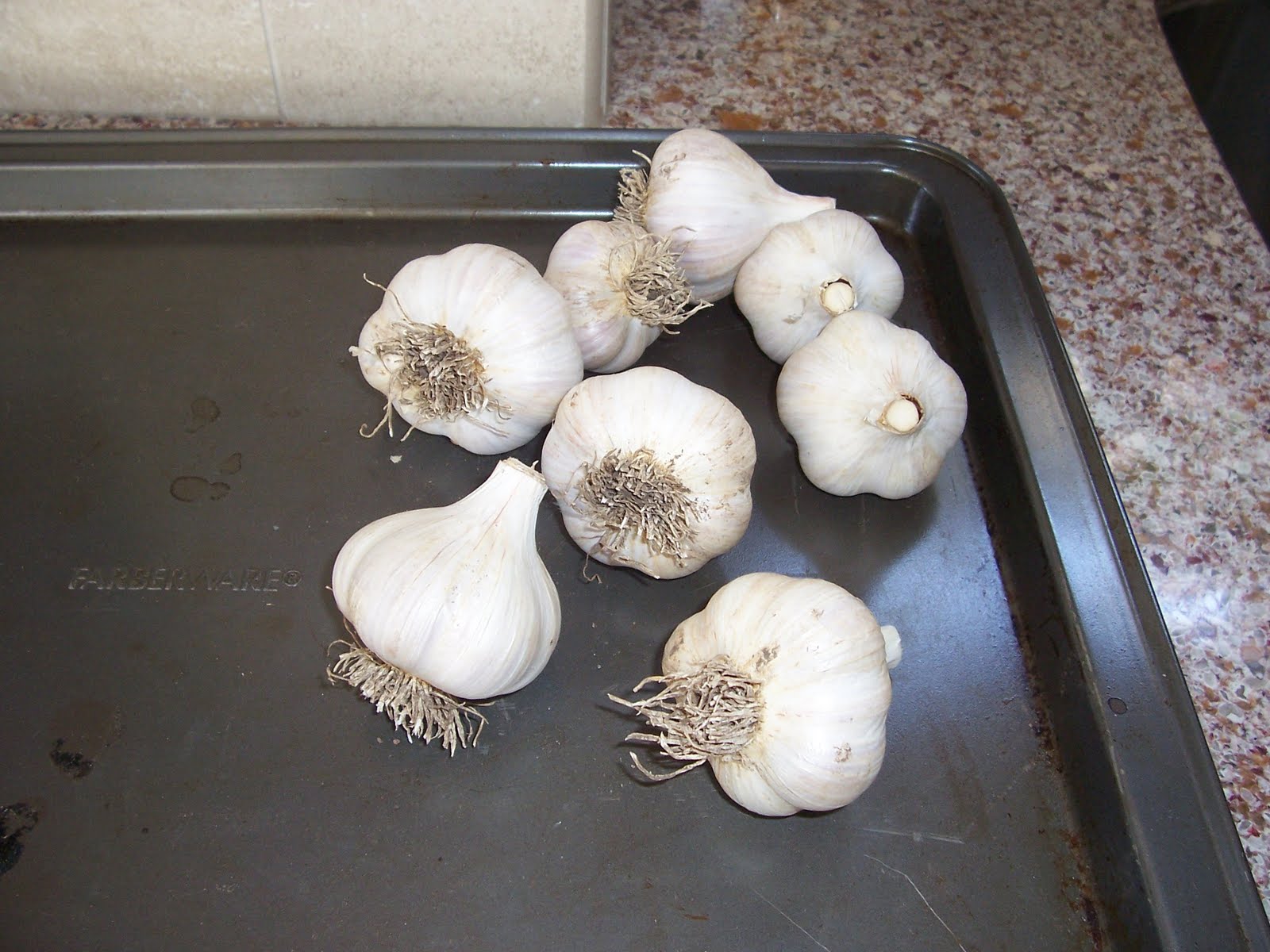
The garlic had also finished its allotted drying time, so I clipped the roots and stems, removed the outer layer of skin, and got these beauties.

The zucchini are now coming fast and furious, and if you wait that one extra day to pick them, they suddenly become the size of baseball bats. The beans are in, and I've planted sweet potatoes where the blue potatoes used to be. The cherry tomatoes are warm and sweet right off the vine, and the cucumbers are crisp and fresh. There is truly nothing like the feeling of farm-to-table, especially when the distance between the two is literally 10 feet!

30 June 2011

Garlic Harvest

The garlic crop told me it was ready yesterday. It did so by standing up straight (the seed heads, that is). Brian took a picture of me yanking them up out of the ground.From stem to stern, the plants were about as tall as I am (5'4"). We composted the leaves and most of the seed heads, but I have two seed heads in a vase in the kitchen; maybe they will mature. I'm a scientist, so I must experiment!I like to give the garlic a week to "rest" before diving in and adding its deliciousness to, well, everything I can! The outer skin is a bit moist from being in the ground, and this helps it dry.When they are ready, I'll give the roots a trim, rub off the remaining soil, and cut down the stalks. Some of the garlic will go to good homes, like my parents'. The third one from the left is the perfect size for a pot of marinara!

The lettuce is still pick-as-you-go, and the bean plants have tiny little beans on them. There are green cherry tomatoes popping up, wee little zucchini and cucumbers, and beets poking up above the dirt. Sometimes I turn over a leaf and find a lightning bug escaping the noontime sun; other times there is an industrious column of ants, or a spider patiently biding its time until a Japanese beetle stumbles into its web (no sympathy for the Japanese beetles here!). Sparrows disappear underneath the bean plants looking for snacks, and the mockingbird flies overhead on its way to scold a stray cat too near its nest. Who said the suburbs are devoid of activity?

22 June 2011

The Cadillac of Flower Pots

First, please let me remind you that I am a meteorologist, not an artist, so my serious lack of skills in Microsoft Paint should be grudgingly accepted by all who view this post.

I just finished watching the NHL awards to bid my favorite sport goodbye until the preseason next fall. When Tim Thomas and Zdeno Chara, of the championship winning Boston Bruins, brought out the Stanley Cup, I had an instant mental image. This is the closest I could get to putting it down on "paper:"
Imagine planting this year's petunias in the Holy Grail of hockey! I mean no disrespect to this greatest of trophies...if you've read or heard any of the myriad stories of debauchery that have gone on around the Cup, even a bowl full of dirt would be cleaner than some of that stuff.

On second thought, this is the Stanley Cup. Petunias might be too common. Maybe some rare heirloom tomatoes instead...

09 June 2011

Let the Farming Begin!

It is super hot out today - 101 Fahrenheit at last count - and our blue potatoes don't look nearly as perky as they do in this photo. Every plant will get a long, cold drink today!
The lettuces, grown from seed from Johnny's, are delicious today. All of them have a delicate taste, and the mesclun mix (the mixed green and red lettuces on the right side) was well designed. I planted extra red sails red-leaf lettuce this year (on the left side) because the marauding groundhog in my parents' yard has eaten theirs right to the ground again.One of my favorite things to grow is garlic. I buy a head of garlic from the place where we go apple picking in the fall (Ochs' Orchard in Warwick, NY) to use as seed, because it is untreated and will germinate well. Each clove in that head gets planted in the fall, and by July, each clove has become a whole new head! When the seed heads (the swirly, smooth green things in the picture) become upright, they are ready to pick.My grandpa's peonies were full of blooms this year, their second blooming season in our yard. Their smell is intoxicatingly beautiful and so alive. My dad even called the white ones prizewinners...
...like this one!