13 February 2012

Great Backyard Bird Count

There's a great opportunity to take part in citizen science this weekend.  The Great Backyard Bird Count (GBBC), sponsored by the Cornell Lab of Ornithology, is from Friday, 17 February through Monday, 20 February.  You don't need a backyard; a park, street, school, etc. are just fine for watching birds.  Just follow these steps:
1.  Watch birds somewhere for at least 15 minutes and write down the largest amount of each species that you see.  (Need help with bird ID?  Try www.allaboutbirds.org, where you can browse species by shape and name.)
2.  Go to www.birdsource.org to enter your count.
By doing this, you contribute to the data pool about birds.  How are they being affected by disease and food availability?  Are there changes in your local bird populations?  Are certain populations declining and need help?  This data can help scientists - who can't be everywhere at once - to answer questions like these.

You can also explore data sets.  The pine siskin is a bird that is not usually found in New Jersey, but will come down this far south during an irruption year, when its usual seed crop in Canada fails.  The following two maps show pine siskins reported through the GBBC during an irruption year, and then a normal year.

It's also interesting to see all the different geographic boundaries of bird species.  Consider four types of chickadees, as shown in the following four maps.


The best part about this data is that it would not be possible without all the citizen scientists...and that it really can help the birds.  Besides, who wouldn't want to watch a cute tufted titmouse like this?
(Google images)

05 February 2012

Hardiness Zone Changes

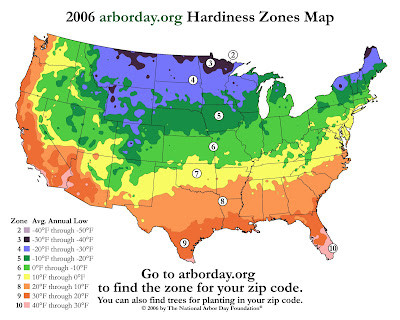
Here's the new Hardiness Zone map for the lower 48, courtesy of arborday.org.  This map has some significant differences from the 1990 map.  The biggest differences are out west.  Areas in the desert southwest have actually lowered a zone (indicating cooler temperatures), while areas west of the central Rockies have increased up to two zones (indicating warmer temperatures); maps of those differences are available at arborday.org. 

Here in northeastern New Jersey, we have gone from zone 6 to zone 7.  What does that mean?  First, we are in the same zone as Oklahoma City, which highlights the moderating influence of the Atlantic Ocean on our climate.  Second, it means that our average annual low temperature has risen.  Finally, it means that we are now in an area where less cold-hardy plants can overwinter without dying. 

It's always good to remember that climate refers to long term patterns in weather.  Last winter, we were buried under feet-worth of snow and freezing.  This winter, our temperatures are running above normal and there have only been two snowfalls of note (and by "of note" I refer to inches, not feet).

If you would like to look up your new hardiness zone, please use the tool on this blog!

21 January 2012

Winter in the Adirondacks

I am not a cold weather girl. The going theory is that I don't have enough fat on me. However, my tall and skinny husband is very at home in the snow, so there goes that theory. Here are some gorgeous pictures from his latest jaunt in the Adirondacks.

26 December 2011

More Farming, More Fun

Christmas for a gardener - for me, anyway - is when thoughts first turn to next year's effort. Assuming that the last vegetables come out of the garden sometime in November, December is usually the first full month of no gardening for me. It's a busy month, so the garden isn't really missed yet; actually, it is nice to have the birdfeeders up in the garden instead, and lots of visitors to watch with very little effort to get them there.
Then, my dad offered to help us dig up the new vegetable plot next spring, as he and my mom gave me a cold frame for Christmas! This means a few things:
1. Gardening season has been extended by 1-2 months on each end of the season. That's 9 months or so of gardening!
2. More gardening time means more planning! I'll be cracking the Johnny's catalog come January.
3. My dad's surprise retirement may mean I'll have a co-farmer this season. Sounds great to me!
4. That milky spore had better be multiplying and killing Japanese beetle larvae. I don't want them eating the swiss chard before we do.

Please excuse the egregious use of exclamation points; I just have visions of corn and kale dancing in my very excited head.